


Beyond the Scan: Turning Cryptographic Discovery into Enterprise Risk Reduction
 By Loren Blinde
November 12, 2026

From IC Insider TYCHON
By Sean Lindsey, Principal Cryptographic Engineer
Your latest discovery run has identified keys, certificates, cryptographic libraries, legacy protocol configurations, and dependencies across the environment. This report is larger than the previous one. Visibility is improving.
Then your leadership asks two questions:
- Which findings should we address first?
- Who owns the work?
If you cannot answer those questions, the organization has useful observations but an incomplete remediation process. Discovery provides the evidence needed to understand cryptographic exposure. Prioritizing and reducing that exposure requires ownership, business context, engineering decisions, and verification.
TYCHON’s discussion of why traditional vulnerability management is insufficient for quantum-era security establishes the need for cryptographic visibility. The next operational challenge is making that visibility useful: turning a detected condition into a justified, assigned, and verifiably completed action.
Start with what the evidence proves
A discovery record should describe what a collection method established, including its limits.
- A cryptographic library installed on a server does not establish that a production application calls it.
- A certificate in a local store does not prove that its associated private key is present or that the certificate is serving a live endpoint.
- A configuration permitting TLS 1.0 does not demonstrate that clients are negotiating it.
These distinctions affect the next engineering decision. An installed component may need dependency analysis. A configured protocol may require an authorized endpoint check. An observed negotiation may justify investigating the client population and transaction path.
Represent installed, configured, accessible, and observed-in-use evidence separately. Record the collection source, scope, timestamp, and relevant limitations. Where evidence is missing, identify the validation needed rather than silently converting an inference into a confirmed fact.
Uncertainty should remain visible even when the dashboard would look cleaner without it.
Ask five questions of every finding
A useful finding should help an engineer answer:
- What was discovered? Identify the artifact or condition precisely: a certificate, protocol setting, library, public-key algorithm, or cryptographic service dependency. Preserve the evidence supporting the classification.
- Where does it exist? Link the observation to the relevant system, application, endpoint, or logical resource. A hostname alone may be insufficient when traffic terminates at a proxy, or a shared platform supports several applications.
- What do we know about its use? Separate capability and configuration from observed activity. State which environment, path, and observation period the evidence covers.
- Who can act on it? Identify the accountable service or application owner and the team authorized to make the change. Those may be different people.
- Why does it matter? Connect the condition to exposure, business criticality, data protection needs, organizational policy, and the consequences of changing it.
Not every answer will be available immediately. Missing ownership, uncertain usage, and unresolved dependencies should become explicit follow-up work. They should not disappear into a generic severity label.
Build a finding that survives handoffs
Different discovery sources can describe the same service from different perspectives. A host collection may identify a certificate file, a network observation may identify a presented certificate, and an asset record may associate the endpoint with a business application.
Correlation should connect those observations while preserving their provenance. It should also retain disagreements. An old certificate on disk and a newer certificate observed at a load balancer may both be valid observations of different parts of the service.
Use stable identifiers where available, normalize names and algorithm labels, and retain the original source records. Merge duplicates only when the matching rules justify it. An IP address or shared certificate alone may not uniquely identify an application.
The resulting finding needs enough context to survive a handoff from discovery analysts to governance teams and then to engineers: affected resource, observed condition, supporting evidence, owner, applicable policy, dependencies, and next action.
This purpose is consistent with the NIST NCCoE Migration to PQC project’s work on using cryptographic inventories to support risk management and prioritization. The inventory should improve decisions about where to act.
Prioritize the service and its dependencies
An algorithm classification is an input to prioritization. The surrounding service determines much of the operational significance.
Consider an externally accessible service protecting information with a long confidentiality lifetime VS a tightly coupled internal application scheduled for retirement. Both may contain cryptographic findings; however, their exposure, business impact, migration effort, and appropriate treatment can differ substantially.
Assess exposure, service criticality, data sensitivity and required protection lifetime, applicable obligations, dependency complexity, and available compensating controls. Include vendor and platform readiness when the remediation depends on capabilities outside the organization’s direct control.
For Quantum Readiness planning, identify the public-key function involved. Key establishment, certificate authentication, and signing introduce different dependencies. NIST IR 8547 provides transition guidance for quantum-vulnerable cryptographic standards; an enterprise still needs to map that guidance to its applications and services.
A high-priority finding may need a migration project rather than a configuration change. Another may first need better evidence. The workflow should make that difference clear.
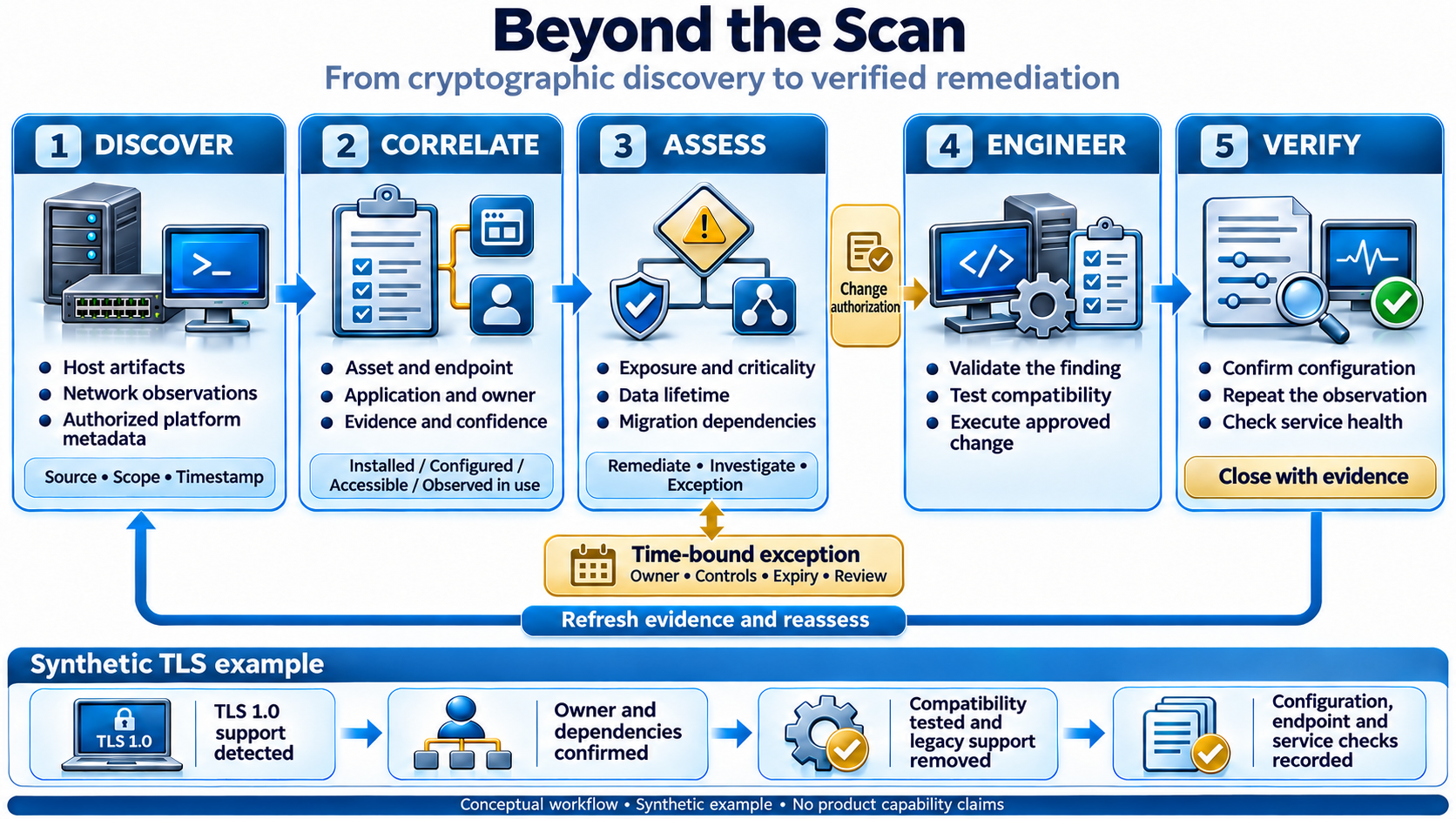
Follow one finding through to closure
Consider a synthetic customer-facing service whose TLS termination configuration permits TLS 1.0. This example illustrates a process; it is not output from a particular discovery product.
First, preserve the initial observation: the configuration permits a deprecated protocol. Do not label it observed client usage. An authorized endpoint test can establish whether the protocol is negotiable on the tested path. Appropriate traffic or connection records may help identify actual client use within the observed scope.
Next, identify the termination point and owner. Is the setting controlled by an application server, reverse proxy, load balancer, or managed service? Which clients depend on that endpoint? Where must the change occur?
RFC 8996 formally deprecates TLS 1.0 and TLS 1.1. The engineering task is to remove prohibited support while confirming that required clients and service functions continue to work. Lack of observed legacy traffic does not establish compatibility across every client or business cycle.
The responsible team tests compatibility, confirms an approved recovery approach, obtains change authorization, and applies the configuration update. Discovery evidence informs that work; it does not authorize a production change.
Closure then requires evidence matched to the original condition: the intended configuration is in place, an authorized repeat check no longer negotiates the prohibited protocol on the tested endpoint, and service validation passes. Record the endpoint, scope, timestamps, results, and approved change reference.
If verification fails, the finding remains open. If a legacy dependency prevents immediate remediation, route it through a documented exception with an accountable owner, risk decision, compensating controls, expiry, and reassessment. An exception records how risk is being managed; it does not make the underlying condition disappear.
Measure what changed
Scan volume and finding counts help describe activity. On their own, they say little about whether an organization can make and verify secure changes.
A growing inventory may reflect better coverage. A shrinking finding count may reflect remediation, a failed collection, lost access, or changed scope. Interpret the numbers alongside collection health and evidence freshness.
Useful operational measures include:
- Ownership coverage: What proportion of validated findings has an accountable owner?
- Action readiness: How many prioritized findings have sufficient evidence, dependencies, and acceptance criteria for engineering work?
- Verified remediation: Which findings were closed with evidence demonstrating the required outcome?
- Exception exposure: Which exceptions are overdue, approaching expiry, or awaiting reassessment?
- Coverage and freshness: Which important services lack recent, successful collection or validation?
Define the denominator, scope, and measurement period. One application may generate many observations, while one shared cryptographic service may support several critical applications. Raw record counts can obscure both situations.
Even verified closure of an individual finding should not be presented as proof that the entire service is secure or PQC-ready. Report the condition addressed and the coverage that remains.
A practical starting checklist
Before adding more dashboard views, take a small set of important findings through the complete workflow:
- Confirm exactly what each observation establishes.
- Link it to the affected service and accountable owner.
- Record the business context and unresolved dependencies.
- Define the required change, acceptance criteria, and verification method.
- Execute through the appropriate engineering and change process.
- Close with evidence or retain a time-bound exception for review.
This connects inventory, assessment, configuration management, and ongoing monitoring: disciplines addressed by NIST SP 800-53 Revision 5. The practical test is whether another reviewer can follow the evidence from the original observation to the recorded outcome.
Cryptographic discovery earns its operational value when teams can explain what was found, why it matters, who is responsible, and what changed. A defensible program preserves that chain of evidence as systems, owners, and standards evolve.
The next question after a scan should be: Which important service can we now improve, and what evidence will demonstrate that the work is complete?
About the Author
 Sean Lindsey, CISSP, is a Principal Cryptographic Engineer at TYCHON with more than a decade of experience in cybersecurity, cryptographic architecture, and enterprise security engineering. Previously, he held senior engineering and leadership roles at Mastercard, where he directed global HSM infrastructure strategy and helped develop enterprise-wide cryptographic discovery, governance, and compliance capabilities. His experience spans payment cryptography, PKI, key management, hybrid cloud security, and the modernization of mission-critical cryptographic platforms.
At TYCHON, Sean brings this operational and architectural experience to advancing cryptographic visibility, risk-based remediation, crypto-agility, and post-quantum readiness, helping organizations translate complex security challenges into practical, actionable strategies.
About Tychon
TYCHON is a NIST NCCoE consortium collaborator and proven cybersecurity innovator delivering automated cryptography discovery and quantum-readiness solutions across U.S. Federal, DoW, and commercial enterprises. Tychon provides instant cryptographic visibility, risk assessment, and compliance reporting for the post-quantum era.
Sponsored content provided by Tychon LLC, a NIST NCCoE consortium collaborator for PQC.
About IC Insiders
IC Insiders is a special sponsored feature that provides deep-dive analysis, interviews with IC leaders, perspective from industry experts, and more. Learn how your company can become an IC Insider.