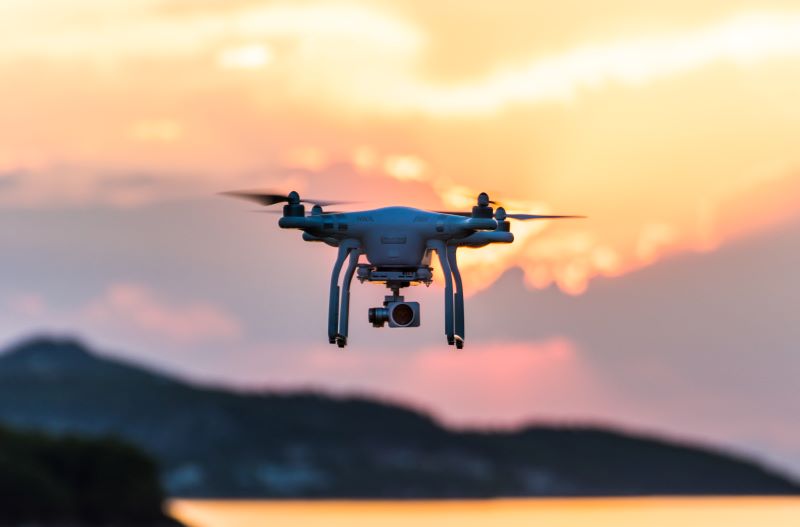
In a recent demonstration, a Lockheed Martin team showed how everyday cellular infrastructure can double as a real-time drone detection system, the company announced March 19. The prototype system, called NetSense, turns commercial networks into an added layer of safety capable of identifying aerial intrusions in crowded or complex environments.
Cell networks are constantly exchanging message signals with phones and connected devices. Those signals form an invisible field of radio frequency (RF) waves that stretch, compress and reflect as they interact with the physical world around them. When something new enters that RF field, like a consumer drone, the change in this field can be observed.
NetSense system capabilities use artificial intelligence to interpret those changes. The system then translates them into simple, immediate cues that help users understand whether something is in the airspace and where it is headed.
In the demonstration, a small drone — that was not connected to the cellular network — entered an area supported by 5G cell towers. That was enough for the NetSense system to raise an alert to activate countermeasures.
During the demonstration, Lockheed Martin’s recently launched STAR.UI software capability gave the NetSense team a user-friendly interface and built-in AI agents to visualize mission-relevant data. The STAR.UI capability is the visualization arm of the STAR.OS constellation, helping to integrate AI/ML capabilities like the NetSense system with mission-relevant data in a highly modular architecture.
Because the NetSense system uses existing 5G towers and off-the-shelf phones as detection receivers, it works without new sensors, special hardware or long installation timelines. It is designed to work with the infrastructure communities already rely on while maintaining the privacy of commercial 5G users on the network.
“Our vision is that this capability will enable situational awareness as a service, providing the actionable insights to our customers as needed and when needed, through the use of existing commercial infrastructure and Lockheed Martin cloud-hosted services,” said Amir Stephenson, director, 5G.MIL programs.
Source: Lockheed Martin
IC News delivers the situational awareness you need to get ahead and stay ahead in the IC contracting space. Subscribe today for full access to 10,000+ articles, plus new articles each weekday.



 By
By